
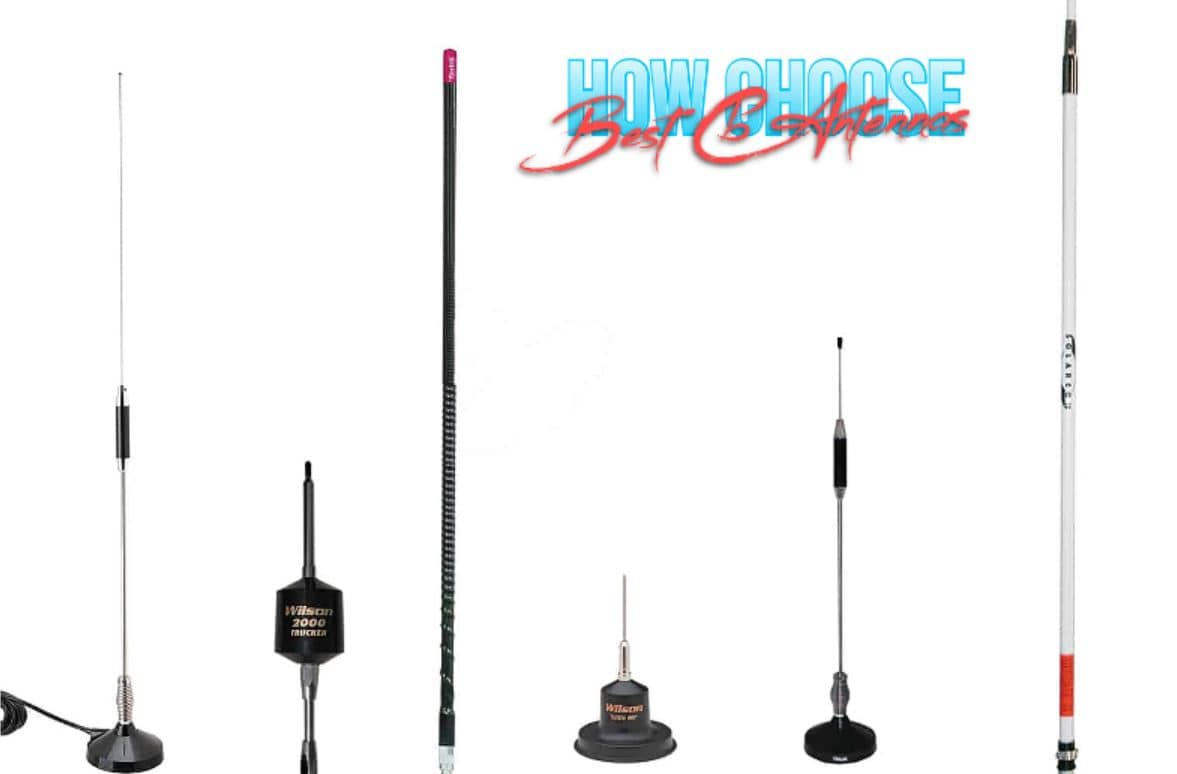
In the era of different types of CB antennas, it becomes really difficult to choose which one suits our CB radios. Is this still difficult for you? Don’t worry, you are at the right place. Today we are going to guide you on how to choose the best CB antenna according to your CB radio.
Are you inside the marketplace for a CB antenna buying guide in 2023? Looking for the best CB antenna? Discover how to choose the best CB antenna for your needs with our comprehensive guide. Explore different types of antennas, and factors like performance, range, length, and construction quality. we’ll cover the specific types of antennas, set-up concerns, and the high-quality brands to be had. whether or not you’re an amateur or a skilled CB person, this guide will come up with all of the facts you want to make an informed decision about your CB antenna buy.
Table of Contents
Introduction to CB Antenna Buying Guide:
The CB (Citizens Band) antenna is made to be used with Citizens Band radios, which are used in the same frequency range as CB radios. They transmit and receive radio signals, making them essential components of the CB radio system. CB radio wires come in different types, including whip receiving wires, fiberglass receiving wires, and attractive mount radio wires. The quality and position of the antenna can have an impact on a CB radio system’s performance, including communication clarity and range.
Considering 5 Important Factors When Choosing An Antenna:
1. No-Ground Plane (NGP) Antennas:
Antennas with a special design known as a No-Ground Plane (NGP) do not rely on a metal surface for optimal performance, such as the body of a vehicle or a ground plane. They highlight an inherent ground plane part or an exceptionally planned matching organization that makes up for the absence of an actual ground plane and are regularly intended for explicit recurrence groups. NGP receiving wires offer a few advantages.
It is essential to take into account aspects like the specific frequency range, gain, and compatibility with the communication system when selecting an NGP antenna. These antennas are designed for fiberglass antennas that are easily installed on boats and vehicles. It is installed over the metal surface of any vehicle. This antenna has a range of 144–174 MHz and a 2.4 dB gain. It is pre-tuned, so you can get a better signal with less noise.
Example: VHF 1/2 Wave

2. Antenna Types by Coil:
CB antennas can usually be grouped into three categories by load position. An antenna’s load function refers back to the location in which the antenna wire is wound into a coil.
As one zone of a wavelength corresponds to 102″, the ideal antenna length for CB frequencies However, attaching a 102″ (8.5 feet) antenna to a vehicle is no longer an option very often.

3. Top-loaded antennas:
Most top-loaded fiberglass antennas have a thin wire wrapped around the antenna shaft. This increases the likelihood they will be higher than the vehicle’s roof, allowing you to lower them. Top-loaded getting wires are used on vehicles, trucks, semis, and donning vehicles.
EXAMPLE: Firestik:

4. Centre-loaded antennas:
Center-loaded is misleading because the coil is not exactly in the center of the antenna. It is closer to the bottom. Under the coil, there is a substantial shaft made of stainless steel. At times, the curl is housed in a plastic housing. The location of the antenna is normal. Center-loaded antennae are most frequently utilized in large trucks and semis.
EXAMPLE: RoadPro

5. Base-loaded antennas:
It has a base-loaded coil and typically has a plastic-covered coil at the antenna’s base. Most of the base-loaded radio wires highlight a base magnet to join a vehicle’s rooftop. They might also use coils that are thicker because the antenna weighs most at the bottom. Base-loaded radio wires normally produce a lot of force. The most common locations for these are on automobile and truck trunks and roofs.
EXAMPLE: K40

6. Mount Size:
Because of the possibility that the magnet mount might come free due to the speed at which the antenna is traveling, a lightweight middle-loaded five-foot fiberglass CB antenna could now not work properly for a small roof magnet setup. Before selecting a CB antenna, verify that the chosen mount will be capable of providing sufficient help.

7. Length:
The length plays a major role in antenna frequencies, as the longer antenna is far better than the shorter antenna.

8. Antenna Brand:
Picking the best brands also provides you with a high-quality and better-performing antenna. e.g., Firestik, Wilson, K4o, etc
9. Mounting Location Considerations:
Placing the antenna in an accurate place is an important part of the process. You can place it at:
- vehicle’s roof
- mirror bars
- hood channel
- bumper
- trunk.
Antenna Performance Vs Budget:
| CB ANTENNA PERFORMANCE | BUDGET |
| Length | Longer antennas generally tend to have better range and signal reception. But, longer antennas can incur greater costs due to the materials required. |
| Construction Quality | cheaper antennas could be manufactured from lower-quality materials, which may have an impact on their toughness and overall performance. |
| Tuning | While less expensive antennas might also require extra work to track appropriately, higher-end antennas may also come pre-tuned or have easier tuning mechanisms. |
| Mounting Options | A more high-priced antenna might include more adaptable and strong mounting picks, letting you place it where it’ll function nicely. |
| Environment | An antenna’s overall performance may be impacted by the environment, mainly topography, obstacles, and interference. on occasion, spending extra money on a better antenna can assist to reduce these outcomes and improve overall performance. |
Types Of Antennas And Their Pros and Cons:
1. Fiberglass Antenna: FireStik FL3-B FireFly.

At the point when you are searching for the best presentation, adaptability, and dependable radio wire then the FIrestik Firefly receiving wire is the most ideal decision to go for. It is planned such that drivers who are enamored with driving in the tree limbs or the carport entryway sort of climate.
Why is it ranked first? Any advice?
because it is most well-liked among well-known automobiles like the Toyota FJ and Jeep Wrangler. Also, it is the most sold item on the lookout for rough terrain vehicles which makes them stand apart anyplace.
With high performance, it also has the ability to maximize the transmission of the function with the top-loaded antenna which receives:
- NOAA emergency
- Weather Alerts
- National Broadcast and etc.
Pros
- The FireFly is only 3 feet tall.
- Good signal strength and clarity, even in areas with a weak signal.
- Comes with all the necessary hardware.
- Made of high-quality materials
Cons
- Does not maintain same ranges due to small size
2. Whip Antenna: Hustler IC-56.

This antenna’s frequencies are set to broadcast and receive signals needed to function between 26.965 and 27.405 MHZ, or about 102 inches or one-quarter wavelength.
Hustler antennas are useful for communicating with two-way radios. You can communicate more effectively using a high-quality 18 feet of coaxial cable and a CB antenna with a waveform of 14 kHz.
The CB whip antenna is extremely robust and adaptable. If you hit something while driving, like a low garage overhang or a tree limb, it is unlikely to break.
The Trickster IC56 has an extra-tall radio wire to assist with lessening the possibility of getting shocked in a tempest. Additionally, the antenna has a unique tip that aids in the elimination of static electricity.
Features:
| Frequency | 27 MHz |
| Design | Stainless Steel |
| Whip | 17-7ph |
| Height | 102 inches (8.5 feet) |
| Tolerance | Resists Bending and Kinking |
| Key | Dissipation Ball Tip Reduces Unwanted Static |
| Welded | 3/8″ x 24 Threaded Base |
| Ability | Bent 180 Degrees and Will Spring Back |
Pros
- known for their high-gain performance.
- Great for long range
- Designed to be weather-resistant
- Available in a wide range of sizes and styles.
Cons
- sightly expensive from other
3. Base Station Cb Antenna: TRAM 1480 Amateur Dual-Band Base Antenna

A special piece of equipment known as a dual-band base antenna enables radio communication between people. With VHF and UHF signals, this is able to perform two distinct functions. These antennas are frequently utilized by radio-loving individuals who place them in a single location, such as a tower or roof.
An 8-foot-tall Dual-Band antenna that can pick up signals on two distinct radio frequencies is the TRAM 1480 Amateur, a specific model. It can deal with a ton of force and makes the signs more grounded.
The TRAM 1480 is a strong antenna made of special material that comes with a piece that makes it easy to put up. It is additionally made to have the option to deal with awful climate and remain solid outside. a few of the originals.
Effective features include:
- 8 ft tall
- High-quality fiberglass designed
- 1480 dual-based antenna
- Comes with an S0-239 connector
- It can be broken into 2 halves and can be adjusted manually with a hex wrench and connected with the connectors.
- 10 inches long antenna radials
- When we put things together correctly, the radio signal works well without needing any changes and also can produce SWR on 2M.
Pros
- Reasonable money easy assembly
- Easy installation process
- There are lines on the antenna that show you exactly how to halve it.
Cons
- The curve that was 70cm long wasn’t good enough.
What To Consider When Installing CB Antenna:
- Locate the location where it is.
- For more attachments, rearrange the antenna.
- Attach the antenna to the brackets or mast.
- Connect it to the coaxial cable.
- Ground the receiving wire.
- Tune the receiving wire appropriately.
- Use an SWR meter to test the signals and the reading.
Frequently Asked Questions:
How far will a 4-watt CB transmit?
Depending on the topography, line-of-sight communication with a CB radio has a range of roughly 3 miles (4.8 km) to 20 miles (32 km); however, under certain radio propagation conditions, contact may occasionally be possible over considerably longer distances.
How do I match my CB antenna?
1. connect The SWR Meter. turn your CB radio off.
2. locate the SWR analysis. switch on your radio and set the CB to channel 20.
3. Repeat Step Two for Channels 1 and 40.
4. examine SWR Readings and adjust if needed.
What is the best length for a CB antenna?
Since 102″ is one-quarter of a wavelength, it is the ideal antenna length for CB frequencies.
How To Choose The Best CB Antenna
The Tornado Stinger is the ideal mobile CB antenna if you’re looking for something simple to use. This base-loaded open coil whip antenna has a robust construction. It does not require tuning.
Summary:
The CB (Citizens Band) antenna is made to be used with Citizens Band radios, which are used in the same frequency range as CB radios. It comes in different types, including whip receiving wires, fiberglass receiving wires, and attractive mount radio wires. When choosing an antenna, it is important to consider five important factors: No-Ground Plane (NGP) Antennas, Antenna Types by Coil, and Top-loaded Antennas.
Fiberglass antennas are commonly used on vehicles, trucks, semis, and donning vehicles. Top-loaded antennas have a thin wire wrapped around the antenna shaft, while center-loaded antennas have a coil closer to the bottom. Base-loaded antennas have a base-loaded coil and typically have a plastic-covered coil at the antenna’s base.
The FireFly is a 3-foot tall, high-performance antenna made of high-quality materials. It has a top-loaded antenna that receives NOAA emergency weather Alerts and National Broadcast. The Hustler IC-56 is a two-way radio with frequencies between 26.965 and 27.405 MHZ.