
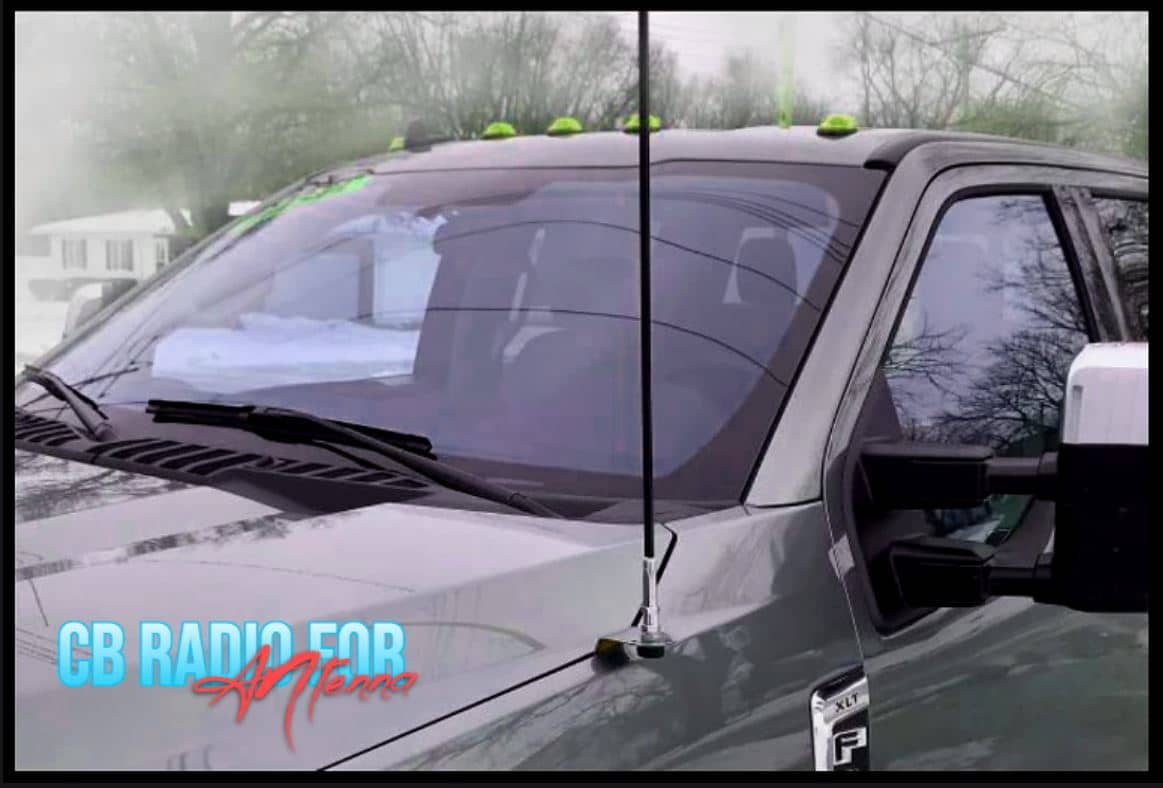
Looking to replace the antenna on your CB radio? Discover our in-depth guide to CB radio antennas, complete with reviews, installation suggestions, and expert advice. Use the best CB radio antenna for your needs to increase the range of your communications and the quality of your signal. Learn about the best CB radio antenna alternatives and important factors to help you make a decision. By using the best antenna, you can maximize the performance of your CB radio. Read our guide to CB radio antennas now.
Table of Contents
Understanding What is Cb Antenna:
The CB radio antenna is a unique type of antenna designed for Citizen’s Band (CB) radios, operating in the 26.965–27.405 MHz range. It is a vertical whip antenna made of fiberglass, with various variants available. The antenna’s performance depends on its length, which can be more challenging to operate and require additional support to prevent bending or breaking. While shorter antennas are more practical, they may not offer the same clarity or range as longer antennas. The ground plane, the conductive surface directly below the antenna, is crucial for efficient performance. This conductive surface can be the luxury vehicle’s body or a separate ground plane kit mounted to the vehicle.
Best Way To Use CB Radio Antenna:
There are many best ways to use these cb radio antennae to communicate across short to medium distances, usually between automobiles or between a vehicle and a fixed base station, where CB radio antennas are employed i.e. Truck drivers, off-road enthusiasts, and other mobile operators who need to connect with each other by the frequent usage of CB radios. These types of special radios antenna include the following areas to be used:
| Areas | Used for |
| Trucking: | Truckers frequently utilize CB radios to share traffic, unpredictable weather, and other crucial updates with one another while they are on the road. |
| Farming & Agriculture: | While traditionally working in the field, farmers and agricultural laborers coordinate their actions and communicate with one another using CB radios. |
| Construction and maintenance: | Construction and maintenance teams frequently utilize CB radios to communicate with one another on social construction and maintenance sites. |
| In instances: | when other kinds of communication are impractical or unreliable, CB radios can in addition be operated for emergency communication |
| Off-Roading: | While exploring isolated locations where mobile phone coverage may be spotty or nonexistent, off-road enthusiasts utilize CB radios to instantly communicate with the other members of their private party. |
Pros
- CB radios are not difficult to operate.
- Ideal for mobile operators who need to keep in touch with people.
- Compared to other communication devices, CB radios and antennas are extremely cheap.
- Remain a cost-effective alternative because they don’t require a membership.
Cons
- They have short to medium-range communication
WHY USE CB RADIO ANTENNA WHEN THERE ARE OTHERS:
The reason for using these cb radio antennas as they are specially made for the frequency of 27 MHz bands. While it is possible to utilize amateur radio or broadcast antennas instead of a specialized CB radio antenna, they might not offer a similar degree of performance or signal clarity.
The following are some benefits of choosing a CB radio antenna over other kinds of antennas:
- Optimal Performance: Carefully compared to other types of antennas, CB radio antennas are capable of providing a more detectable, clearer signal since they are made to work optimally at the specific frequency range utilized by CB radios.
- CB radio users who eagerly seek dependable performance without breaking the bank may find CB radio antennas to be a more cost-effective solution because they are often less expensive than other types of antennas.
- Compact Design: CB radio antennas are frequently made to be relatively small, which makes it simpler to place them on cars or in other confined locations.
- Excellent durability: CB radio antennas may endure for years before needing to be changed since they are produced to resist harsh weather and rigorous handling.
7 BEST CB RADIO ANTENNA:
1. WILSON 1000 MAGNET MOUNT CB ANTENNA:

Popular high-performance CB antenna for mobile use, the Wilson 1000 Magnet Mount CB Antenna. It is easy to install and remove as required thanks to its 10-inch magnet mount base and 62.5-inch stainless steel whip. The Wilson 1000 Magnet Mount CB Antenna has the following advantages and disadvantages:
Pros
- The Wilson 1000 Magnet Mount CB Antenna is a prominent long-range performer, making it a great choice.
- The antenna’s magnet mount base makes it simple to install.
- CB radio antennas are frequently less expensive than others.
- Because CB radio antennas are built to withstand severe weather and rough usage.
Cons
- Users who need a smaller or more compact antenna may find the antenna’s 62.5-inch whip to be too lengthy.
2. FIRESTIK FS SERIES CB ANTENNA:

For mobile and base station use, the Firestik FS Series CB Antenna is a well-liked and dependable CB radio antenna. Because it is adjustable, customers may alter the length for the best possible signal transmission. The Firestik FS Series CB Antenna has the following benefits and drawbacks:
Pros
- A simple setup that most people can perform.
- Offers excellent performance and the capacity to send and receive messages over great distances.
- Because the antenna is tunable, users may modify its length.
Cons
- Find the Firestik FS Series CB Antenna to be pricier than some other CB radio antennas on the market
3. K40 SF-400 BLACK CB ANTENNA:

High-performance CB radio antenna with a mobile design, the K40 SF-400 Black CB Antenna. It is an adaptable antenna that may be put on many different vehicles, like automobiles, trucks, and recreational vehicles (RVs). The followings are some advantages and disadvantages of the K40 SF-400 Black CB Antenna:
Pros
- Good performance
- versatile mounting options.
- affordable
Cons
- This may require tuning for optimal performance.
4. PREDATOR 10-K CB ANTENNA:

The Predator 10-K CB Antenna is a dominant, transportable antenna with heavy-duty construction. Listed at the end are some advantages and disadvantages of the Predator 10-K CB Antenna:
Pros
- Has outstanding signal strength and clarity.
- The antenna retains an aggressive stainless steel design.
- The antenna’s length may be altered to enhance performance in various settings since it is adjustable.
- The antenna may be used with a range of CB radios and frequencies because of its wide bandwidth.
Cons
- For some cars or in some areas, the antenna’s length may be a drawback for some users.
5. SOLARCON A-99 CB BASE STATION ANTENNA:

When seeking a high-performance, simple-to-use base station antenna, CB radio enthusiasts frequently choose the Solarcon A-99. The Solarcon A-99 CB Base Station Antenna has the following benefits and drawbacks:
Pros
- The antenna is a high-performance antenna that transmits crystal-clear audio.
- The antenna has a tough fiberglass structure that can withstand adverse weather.
- ther and rigorous handling. It is produced to last.
- The antenna is comparatively light, which makes mounting and adjusting it simple.
Cons
- The antenna can require a ground plane or other accessories to work at its best in specific conditions.
6-cobra-hg-a-1500-cb-base-station-antenna

When seeking a high-performance, simple-to-use base station antenna, CB radio enthusiasts frequently choose the Cobra HG A1500 CB Base Station Antenna. The Cobra HG A1500 CB Base Station Antenna has the following advantages and disadvantages:
Pros
- The Cobra HG A1500 CB Base Station Antenna is a high-performance antenna that transmits good signal strength over extended distances.
- A simple setup procedure that most individuals can accomplish.
- The Cobra HG A1500 CB Base Station Antenna is compatible with the majority of CB radios.
Cons
- The antenna’s effectiveness may be constrained, in particular, at locations.
7. TRAM 703-HC CENTER LOAD CB ANTENNA:

When searching for a dependable and simple-to-install antenna for their mobile CB radio, consumers frequently choose the Tram 703-HC Center Load CB Antenna. The Tram 703-HC Center Load CB Antenna has the following advantages and disadvantages:
Pros
- The antenna is straightforward and can be done by the majority of users with only a few standard tools.
- The antenna may be mounted on most cars without taking up much room because it is quite small.
- For CB radio users expect high-quality performance without breaking the bank.
Cons
- Due to the antenna’s miniature size, it may not function as well over longer distances or in places with faint signals.
INSTALLATION METHOD:
- The antenna should be placed in a location that is free of obstacles, away from other electronic equipment, and in a position that provides the best possible signal transmission. Routinely, the car’s roof or trunk provides suitable locations.
- Make sure the mounting surface is clean, dry, and clear of any dirt or debris that could get in the way of the magnet mount.
- Install the Magnet Mount: Fasten the Magnet Mount to the area of your car that you’ve chosen. Make sure the magnet mount is firmly fixed and won’t slip or shift while in transit.
- Install the antenna by fastening it to the magnet mount base while making sure the connector is snug.
- The antenna should be adjusted so that it is standing straight and erect and at the exact height and angle.
- Run the coaxial wire: Make sure the coaxial cable is secured and not twisted or pinched when you run it from the antenna to the CB radio.
- Connect the cable to the CB radio: Attach the coaxial cable to the antenna jack of the CB radio, making sure to clamp it down firmly.
- Test the antenna: Switch on your CB radio and assess the effectiveness of the antenna. To get the strongest signal and most explicit reception, adjust the antenna as necessary.
Keep In Mind:
To prevent any legal snags, it is crucial to ascertain and abide by any local laws and rules that may apply to the use of CB radios and antennas. Make sure your antenna is correctly grounded to prevent interference and boost signal strength. A capable ground plane is crucial for the best performance of a CB radio antenna. High-voltage power lines should be avoided since they might interfere with CB radio signals.
As a result, stay away from these power lines when operating your radio. Keep an eye on the antenna height, If your CB radio antenna is too high or extremely low, it may affect the radio’s performance and range. Be mindful of the weather. Lightning and other harsh weather might result in electrical interference, which can affect how well your CB radio antenna works. During these kinds of weather, stay away from your radio. Be careful while changing your antenna, and always switch off your CB radio before doing so to prevent electrical shock or equipment damage.
FREQUENTLY ASKED QUESTIONS:
Q. Which CB antenna has the longest range?
The stainless steel 102″ whip antennas have the maximum range but may not be suitable for parking in garages, beneath trees, or other locations. The transmit and receive ranges of the single center load antenna are comparable to those of the whip.
Q. Is a taller CB antenna better?
When it comes to an antenna, taller/longer is better for the range of distance, and the ideal antenna length is 1/4 wavelength. That is 102 inches, which is too tall for the majority of mobile apps (8.5 feet).
Q. Is it better to have 2 CB antennas?
When that happens, having two antennas is useful. Because the antenna system can “see” more when your car has antennae on both sides, you’re considerably less likely to see significant dead areas. This is one of the main justifications for multiple antenna configurations on most 18-wheelers.
Q. What is the strongest CB radio?
Ranger RCI69FFB4 Description Faceplate is now BLACK rather than chrome. Welcome to the Ranger RCI 69FFB4, the most powerful CB radio on the market. With more than 400 watts of Pep, the Ranger CB radio outperforms all others in terms of power.
SUMMARY
CB radio antennas are essential for various applications, such as trucking, farming, construction, and off-roading. They provide a reliable and affordable communication solution for mobile operators, as they are designed for the frequency of 27 MHz bands. These antennas are easy to operate and are ideal for mobile operators who need to keep in touch with people.
CB radios are particularly useful for trucking, agriculture, construction, and maintenance, as they are designed to work optimally at the specific frequency range used by CB radios. They are also used by construction and maintenance teams to communicate on social construction and maintenance sites. In cases where other forms of communication are impractical or unreliable, CB radios can also be used for emergency communication.
In conclusion, CB radio antennas are essential for various applications, including trucking, agriculture, construction, and off-roading. They offer a wide range of communication options and are suitable for various applications, making them an essential choice for those seeking reliable and affordable communication solutions.